
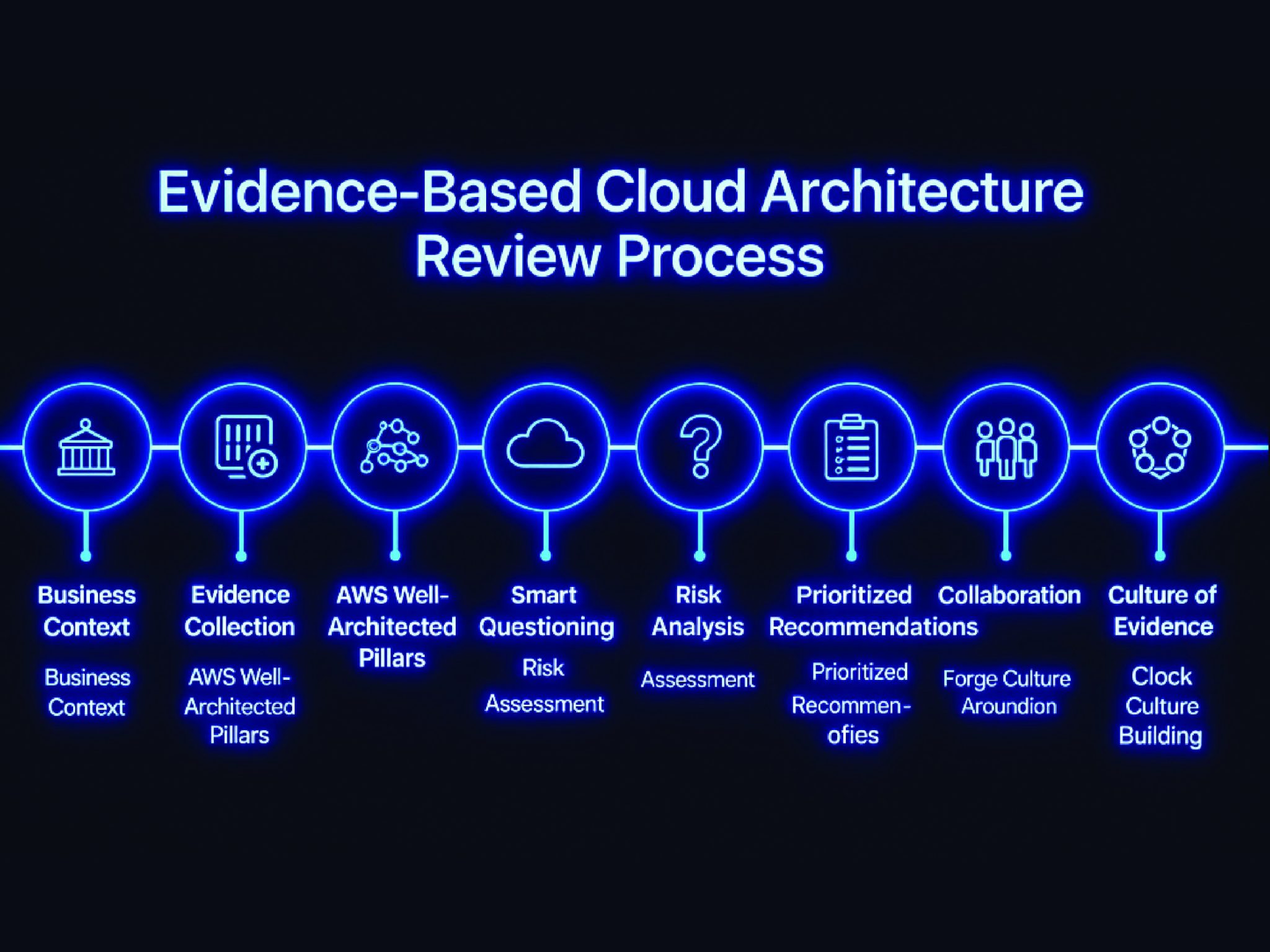
Cloud architecture is more than wiring services together — it is the craft of aligning systems with meaningful business outcomes. Yet too often, reviews become checklists or opinions, not rigorous examinations of reality.
What separates a trusted advisor from a well-meaning reviewer is the commitment to evidence over assumption, questions over guesses, business context over technology for its own sake.
In this article you’ll discover a step-by-step framework for reviewing any cloud architecture — one that captivates directors for its clarity, empowers engineers for its precision, and earns trust from executives for its alignment with business goals.
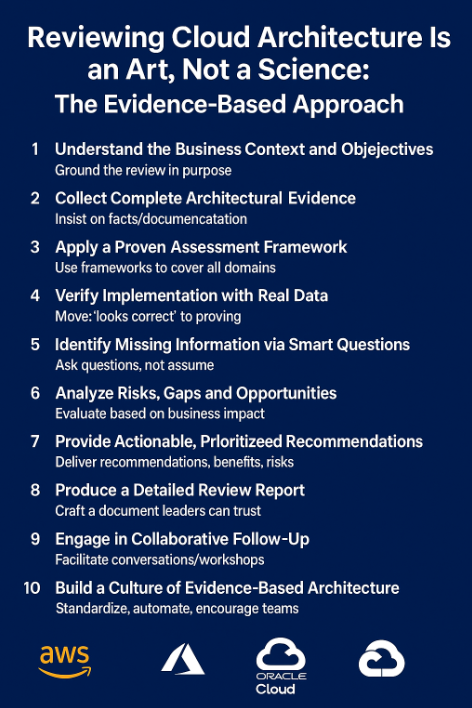
1.Understand the Business Context and Objectives
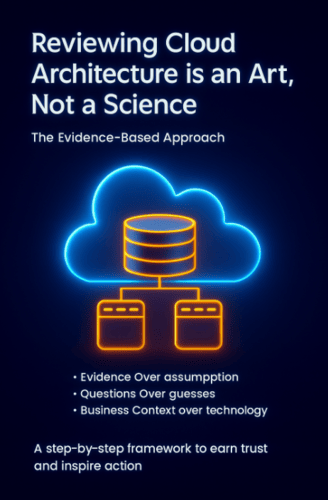
Every architecture solves a business problem.
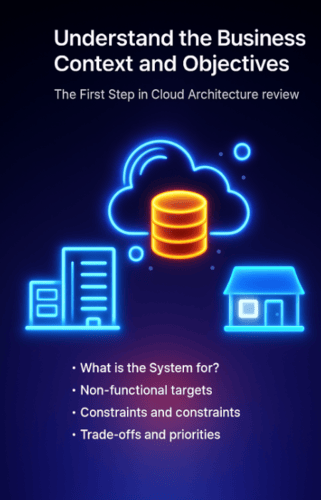
Before opening consoles or YAML files, ask:
- What is the system for? (Availability? Compliance? Cost reduction? Speed to market?)
- What’s the non-functional target? (RTO/RPO, latency, SLA, data residence)
- What constraints are in play? (Regulation, budget ceiling, tooling lifecycle, team skills)
- What trade-offs were made, and why?
This step grounds the review in purpose. A technically elegant design that misses the business mark is still a misalignment.
2.Collect Complete Architectural Evidence
Assumptions are the enemy of clarity. Insist on the facts:
- Architectural diagrams (logical & physical)
- Component inventories (compute, storage, network, IAM, data stores)
- Infrastructure-as-Code files (Terraform, CloudFormation)
- Deployment pipelines & runbook documents
- Monitoring dashboards, alerts, incident logs
- Network layouts and IAM policy snapshots
If something isn’t documented, it isn’t verified. Asking for a screenshot or console export is not optional — it is essential.
3.Apply a Proven Assessment Framework
Structure enables both consistency and depth. The AWS Well-Architected Framework defines six pillars — Operational Excellence, Security, Reliability, Performance Efficiency, Cost Optimization and Sustainability. (AWS Documentation)
Use such frameworks (or cloud-platform equivalents) to ensure you cover all domains, not just what you already know.
Pillar | What it helps evaluate |
Operational Excellence | How we operate, monitor and evolve systems |
Security | How we protect data, identities and systems |
Reliability | How we tolerate failure & ensure continuity |
Performance Efficiency | How we use resources to meet demands |
Cost Optimization | How we avoid waste & align spend to value |
Sustainability | How we minimise environmental & operational waste |
4.Verify Implementation with Real Data
Avoid “It looks correct” thinking — ask: “Prove it.”
- Use AWS Config, Trusted Advisor, GuardDuty, Security Hub for configuration data.
- Pull IaC state rather than rely only on documentation.
- Review monitoring metrics (latency, error rates, resource utilization).
- Validate backups, incident logs and change-history.
- Map actual state against architecture drawings.
An architecture review is not speculation — it is evidence-driven inspection.
5.Identify Missing Information via Smart Questions
When visibility is incomplete — ask rather than assume.
Good examples:
- “Are EKS control-plane logs flowing into CloudWatch?”
- “Which IAM roles map to Kubernetes service accounts?”
- “Is there a documented RTO and recovery drill for our Redis cache?”
Maintain a question log — every unknown becomes a question, not a guess. That’s the sign of a disciplined architect.
6.Analyse Risks, Gaps and Opportunities
With data and answers in hand, evaluate:
- Security risks (e.g., unrestricted roles, public egress)
- Reliability gaps (single-AZ, missing backups, no DR plan)
- Performance bottlenecks (unbounded scaling, storage mis-tuning)
- Cost drain (idle instances, unmanaged logs, inefficient storage)
Prioritise based on business impact & likelihood — not just technical curiosity.
7.Provide Actionable, Prioritised Recommendations
A review without action is noise.
For each pillar deliver:
- What needs to change
- Why it matters
- Expected benefit or risk reduction
- Evidence or metric supporting it
Use a simple model — eg: Critical / Recommended / Good-practice — and link each recommendation back to a business goal.
8.Produce a Detailed Review Report
Craft a document leaders can trust and engineers can act on:
- Executive summary (key findings, business impact)
- Evidence table (screenshots, logs, config snippets)
- Pillar-wise findings and status
- Question log (open items)
- Recommendation roadmap with owners & timeline
Make the results traceable and repeatable.
9.Engage in Collaborative Follow-Up
Reviews succeed when teams take ownership.
Facilitate:
- Workshop sessions with architecture, security, DevOps teams
- Clarify open questions and co-create remediation stories
- Track progress in a ticketing system (Jira/Confluence)
- Re-review on a cadence (quarterly / bi-annual)
Architecture review is a conversation — not a verdict.
10.Build a Culture of Evidence-Based Architecture
The best architects teach teams to think this way:
- Standardise evidence-collection forms
- Automate review checkpoints where possible
- Encourage self-reviews and peer-reviews
- Archive every review as a case study
When teams routinely ask “What is the evidence?” instead of “What do we think?”, then architecture becomes not just about structure, but about trust.
Final Thought
“Reviewing cloud architecture isn’t about knowing everything — it’s about asking the right questions and validating them with data.”
Science gives you information. The art of architecture gives you judgement.
Master both — and you move from being a reviewer to being a trusted advisor who shapes clarity in the cloud.